Archive
Chapters: Prologue · The fabulous ’80s · Pascal and beyond · An ambitious project · The Internet · The server side · Security manager · Network administrator · Networking Academy · Systems administrators · Epilogue
A Short ComputerBiography
Of one thing I am sure: unless you are someone famous, your biography is of little interest to anyone.On the other hand, introducing yourself to your visitors is a simple courtesy that no good host should neglect.
In my case, that good habit could easily have been dealt with in three lines, but I thought I would offer something different and, I hope, more interesting.
So, under the pretext of a few biographical notes, I tell what it was like to live through those “formidable years” when distributed computing was born and a new way of communicating and of accessing knowledge took shape.
We had the feeling, back then, of living through one of those moments when History suddenly speeds up the flow of events and forces rapid cultural and social change. New ideas and technologies took hold and evolved so quickly that they seemed almost impossible to keep up with. A lively, energetic climate, a new Zeitgeist, heralded the dawn of the age of Information and Communication Technology.
And, as the saying goes, nothing would ever be the same again…
Prologue
 I graduated in Physics, specializing in nuclear physics, from the University of Padua in June 1978, and a year later I started teaching in high school. After graduating I became interested in computing, since at university I had received only a smattering of Fortran. Fortunately, a few enlightened professors had realized that an aspiring physicist should at least know the rudiments of computing. The university computer center was off-limits to students. Programming in those days meant batch processing: you wrote your programs, punched them onto cards and handed the deck to the center’s administrator, who ran them whenever possible, according to various priorities. A few days later you got back the printouts with the results. If there was a mistake, and there almost always was, you had to fix it, replace the card or cards and go through the whole procedure again. Just imagine having students underfoot as well.
In the beginning: the fabulous ’80s
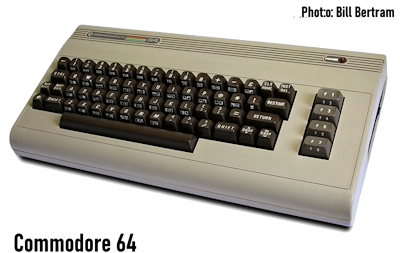
Like many of my generation, then, I started out programming the legendary Commodore 64, which was being sold in Italy at the time.The “64” in its name stood for exactly 64 KB (64 × 8 × 1024 = 524,288 bits) of RAM, and not even all of it was available, since part of it was taken up by the operating system.
Today (author’s note: in 2008), by comparison, RAM capacity is measured in gigabytes (1 gigabyte = 109 bytes or, more precisely, 10243 = 230 bytes).
The price was outrageous. In December 1982 I paid 1,200,000 lire for my C-64 (about €2,250 in today’s money, allowing for inflation).
And yet, with those few, expensive kilobytes we worked miracles, at least by the standards of the time: games, applications, complex and highly optimized programs, because we could not afford to waste a single bit of memory.
In those years of great enthusiasm for the new technology I taught a few “pioneering” computer courses for school staff. I am talking about the early 1980s, and computing in schools really was pioneer territory.
 To most people the computer looked like some kind of magic box. I had felt much the same a few years earlier when, in the Physics Lab 1 course, I got my hands on one of the first electronic calculators on the market, the HP-45, which was firmly bolted to the wall because it was so valuable ($395 in 1974, or 250,000 lire, more than an average monthly salary at the time and the equivalent of over €2,000 today).
Calculations were done in the efficient but thoroughly unnatural Reverse Polish Notation (RPN). For example, to compute 5 × 3 you had to press


 , and the display showed the result, 15 (there was no = key). You can try it yourself by clicking the picture of the HP-45, which opens a simulation (of its predecessor, the HP-35) written by Neil Fraser for the Museum of HP Calculators.
Later, while working with one of the first associations of teachers convinced that computing had to be brought into schools (which, with stunning imagination, we named “Informatica & Didattica”, Computing & Teaching), I worked with the Olivetti M20 (one of the few personal computers of the period with “high-resolution” graphics and commands to handle them: Olivetti was then at the cutting edge of personal computing research and development), then with the IBM PC (the worst of the lot, I think) and finally with the trusty Olivetti M24.
At the time, a colleague and friend and I were writing a program to solve electric circuits: you drew the circuit with graphic symbols for the components (nodes, wires, sources, resistors, inductors, capacitors), and the program, written in GW-BASIC, worked out its topology and computed the currents and voltages. It was the first fairly complex project we took on, and it taught us a great deal about programming and its tricks.
Then came the powerful Apple Macintosh Plus, with its extraordinary windowed operating system (later widely imitated by others) that you used not only with the keyboard but also with a revolutionary pointing device: the mouse.
Pascal and beyond
People were beginning to talk about structured programming and about Pascal, and about bringing it into schools precisely because of its rigor: strong typing (variables had to be declared in advance, and you could not switch from one type to another with a simple assignment, as you could in BASIC) and modularity through procedures.Compared with BASIC it was another world: from “spaghetti code”, riddled with GOTOs and variables created on the fly, to the Swiss orderliness imposed by Niklaus Wirth.
And then there was speed. It may be hard to appreciate today what having a good compiler meant. Our computers are now so powerful that even an interpreted program performs quite acceptably, at least for everyday tasks, although a delay of a few seconds is enough for us to call a program slow, or very slow. Back then you could wait for minutes!
Right at that time, from 1983 onward, Borland was selling a lightning-fast, low-cost compiler for MS-DOS: Turbo Pascal.
It was a huge success: it quickly became by far the most popular compiler and was adopted by many universities to teach structured programming.
With version 5.5 (1989) Borland also introduced object-oriented programming. Programs were no longer to be conceived as a mere sequence of instructions, but as a set of interacting objects.
Objects are concrete realizations of classes: they are instances of a class, and they have properties (the object’s data) and the ability to act (the object’s methods).
A class is an abstract data structure that defines the general properties (the data) of every object belonging to it and what each of them can do (the methods). For example, the class Car defines the concept of a car (what is it that tells us the thing in front of us is a car?), while a “Fiat 500” and a “Ferrari F430” are concrete realizations, instances, of Car.
All this was truly fascinating, if a little hard to grasp for those of us used to programming the old way. The little guide
 to object-oriented programming that came with the compiler, however, was quite clear and a great help. So much so that I still think it is useful for anyone taking their first steps in programming. The complexity of today’s software makes the object-oriented approach a necessity, and all modern languages have adopted it: Delphi, C++, Java and so on.
Meanwhile hardware was moving on: from the Intel 80286 of the early ’80s to the groundbreaking 80386, Intel’s first 32-bit processor. Mine cost me an arm and a leg, partly because I insisted on a brand-name machine (an Intercomp x386) complete with an 80387 math coprocessor, which was required by particularly demanding applications such as AutoCAD.
An ambitious project
Once I had a good command of Pascal, I threw myself into an ambitious project: a series of physics simulations to make electromagnetism easier to learn.I had to design simulations that were effective for teaching and genuinely interactive. What was available at the time was not up to much: little interactivity and ghastly CGA graphics, 320 × 200 pixels in 4 colors, whereas the new EGA and VGA cards finally allowed 640 × 480 pixels in 16 colors.
I decided to start with Coulomb’s law. My idea was to simulate a two-pan balance (1)
 with an electric charge on one pan and a second charge that could be moved closer or farther away. A ruler measured the distance. By changing the weights on the other pan, the student had to balance the scale and so find the strength of the electrostatic force at various distances and for different values of the charges.
I had to build everything from scratch: the graphics, the animation and the physics engine needed to make the motion of the pans realistic and the results reliable. I wanted the simulation to be realistic enough, so the equations of motion had to be solved properly; I used Euler’s method. Then there was the problem of processing the data.
The key idea was that students would choose a strategy (which parameters to vary, and how), collect a set of data and then, by processing the data and plotting them, work out Coulomb’s law for themselves.
So I thought of building in a spreadsheet, in the style of VisiCalc or Lotus 1-2-3, but it seemed far too complicated, and frankly the idea was a little too bold for my abilities. Yet if I pulled it off, I would have achieved something important: a self-contained learning environment, simulation and data analysis without ever leaving the program. Quite a challenge! I decided to give it a try, putting into practice some of the object-oriented concepts I was studying at the time. So I created a “cell” class, with its data and methods. The table then had to be as modular as possible, so that the code could be reused in later simulations without any changes.
Cells could hold text, numbers and formulas, either with explicit values or referring to the contents of other cells. With future developments in mind I implemented a few functions: powers, square root, trigonometric functions (sin, cos, arctan), natural logarithm and exponential. The result was rather primitive, but more than enough for the purpose.
Next came the graphs. Writing procedures to plot given functions was not particularly difficult. From a teaching point of view, however, it was important that students typed in the mathematical function themselves, rather than choosing from predefined ones. So virtually any polynomial function had to be plotted, along with trigonometric, logarithmic and exponential functions. Since functions were entered in a text box, I had to write a multilevel parser able to analyze input such as f(x)=1/(x^3 - 3*x^2+1). The program then had to skip the singular points of the domain, to avoid the dreaded “Division by zero” error, and strike a reasonable balance between plot quality and running time (my first attempts were pretty hopeless on that score). Frankly, these were the parts I found hardest. I worked hard, and in the end I had my simulation up and running. And it worked well, I must say.
 Now I had to figure out what to do with all that work. I put together a demo and sent it to a few publishers, who liked it but turned it down (perhaps also because of earlier unsuccessful ventures). Only one, the publisher La Scuola in Brescia, instead of the usual letter, had one of its managers call me. He said they were sorry they could not publish a work of that kind, given the company’s policy at the time, but they wanted to make use of my skills and asked me to write a few articles for their prestigious journal Nuova Secondaria, which I did.
Reading MCmicrocomputer, a well-known Italian computer monthly of the time, I came across an ad in which Simulmondo, a Bologna software house then famous for its video games, was looking for partners for other projects, including educational software.
I sent them the demo and an outline of the idea. I was invited to Bologna for an interview, and out of it came a project to publish two volumes on electromagnetism, Fisica 2 and Fisica 3 (Physics 2 and 3; Fisica 1 already existed). I threw myself into it, following the same guidelines. This time, though, the simulations had to come with a text and a set of exercises. So I came up with a text on three levels connected by “hot words” (today I would call them links) that you moved through with the arrow keys (still no mouse), jumping from one level of text to another. Without knowing it (I had not yet heard of what was going on at CERN in Geneva, nor of the earlier research), I had built a rudimentary kind of hypertext. I then added a set of questions whose answers were checked for logic and syntax. Within a few months I finished the first volume, which was published in 1992. I also started on the second one, but because of internal problems at Simulmondo it was never completed.
For vintage software enthusiasts and the simply curious, these programs can be downloaded free of charge from the Materials section of this site.
Meanwhile, a new interest was looming on the horizon.
The Internet
Between 1989 and 1991, at CERN, Tim Berners-Lee and Robert Cailliau developed a hypertext system to help researchers find information and work together, defining both the markup language (HTML) and the transfer protocol (HTTP). On August 6, 1991, Tim Berners-Lee published the first website on the Internet. In 1993 CERN put the World Wide Web (WWW) into the public domain.
The following year, 1994, the first public Internet access services became available in Italy too.
In 1996, armed with a 14.4 kbit/s modem and the Netscape 2.02 browser, I joined the million or so Italians on the Internet. Seeing pages from all over the world appear on my screen was quite a thrill. So was the sense of disorientation, like setting out across a boundless territory without landmarks, signposts or maps. Salvation came (and still comes) from search engines. At the time the most popular were Yahoo, which gave the best results because its sites were selected and cataloged by human editors, and AltaVista, which boasted one of the largest databases on the Web. What might strike us most today is how slowly pages loaded. To give you an idea, the picture of the Commodore 64 on this page is about 60 KB, that is 60 × 1024 × 8 = 491,520 bits. With my modem it took 491,520/14,400 = 34 seconds, more than half a minute, to download it. Today a 1 Mbit/s ADSL line (1,048,576 bit/s) downloads the same picture in 491,520/1,048,576 = 0.47 s, half a second! That gives you a sense of how far we have come, and of how much patience you needed back then…
I was burning with curiosity to understand how it all worked. So I went back to studying: I learned HTML and built pages that left me rather unsatisfied, because they had almost no interactivity. I discovered JavaScript (I knew a little Java and C, and the similar syntax helped) and so, little by little, I entered the world of scripting. I got pretty good at web pages, good enough to build a few sites professionally; in fact, for a while I worked as a web developer and consultant.
There was a lot to learn, but most of the knowledge and of the answers to my problems could be found on the Net itself. That was, in a sense, the revolutionary thing: the Net provided the means to study it, understand it and talk about it. Little by little the Internet was becoming the greatest source of information and the greatest place for collaboration ever. Countless sites and people made their knowledge and their work available to anyone, asking nothing in return. Extraordinary. My only regret was that I had discovered it so late: online collaboration and communication had existed for some time, in Italy and around the world
 , for example the FidoNet network, from 1986 until the so-called Italian Crackdown of 1994, and Usenet.
I was still interested in using these new resources for teaching, so I organized a course on HTML and basic JavaScript for a group of colleagues and a few students, who could then use what they had learned in their own teaching and studies.
In the meantime, my need to understand how the Internet worked was leading me to study computer networks. New terms were appearing on the horizon: Ethernet, TCP/IP, CSMA/CD, packets, routers and so on.
The server side, or crossing over
By now I knew quite a lot: I could design web pages, I knew how to upload them to a server and I even had an idea of how it all worked. But what lay at the other end of the phone line, dutifully answering the user’s (that is, the browser’s) requests for this or that page, remained vague and hazy. The only way to really understand how things worked was to get my hands on a server.My chance came in 1999–2000, when I teamed up with a long-established local software house, founded and run by a typical eccentric genius, as brilliant as he was disorganized. For years the company had been working on Unix systems, running custom business software that it also maintained remotely over modem-to-modem phone connections (not yet over the Internet). We pooled our forces and our skills to build an Internet-based e-commerce system. I had to learn from scratch how to set up a server, first under Unix (we used SCO and Caldera) and then, for good, under Linux. That was my first encounter with open source, with Linux… and with Perl.
Perl is one of the most unforgiving server-side scripting languages I have ever worked with, but at the time it was the best way to connect the web pages (the system’s front end) to the powerful relational database at the heart of the application. It was an exhilarating experience. We worked side by side, often late into the night, spurred on by the enthusiasm of the sales manager (who later became a close friend): one of us programmed the database while the other came up with the Perl solutions it needed. A problem, a solution, another problem, another solution… almost in real time. It really felt like the early days all over again. Bit by bit we watched our creation take shape: we were among the first in Italy to build an e-commerce platform, with a web interface written entirely in-house.
I gained a wealth of experience from it, but I felt the need to organize and deepen the knowledge I had picked up along the way.
Security manager
In 2000 it was estimated that Italy would soon be short of more than 50,000 IT experts able to work in the so-called net economy, the part of the economy that relies on network resources. To limit the damage this “skills shortage”, as it was called, was bound to cause, a group of banks led by Sviluppo Italia funded the Skillpass project. The aim was to train at least 10,000 experts free of charge within a year and get them into work. To be admitted you had to pass a selection process, answering an online questionnaire and sending in your résumé. I was selected and chose the Security Manager track, which seemed to best fit my needs. Lessons were delivered over the Internet and by videoconference by Global Knowledge, while the labs were held at its Milan offices. In practice I took an introductory course on computer networks, the preparation course for the Cisco CCNA certification (Interconnecting Cisco Networking Devices), one of the three courses for the CCNP (Building Cisco Remote Access Networks, now Building Scalable Cisco Internetworks) and a specialized course on security management in Cisco networks. The work was quite demanding, with interim tests on strict, non-negotiable deadlines. In 2001 I passed the final exam and at last had the skills to run a medium-sized network, configuring routers, switches and authentication systems.Network administrator in my spare time (and at no cost)
Naturally, all this had an impact on my school. I pushed hard for an internal network and in the end I got my way: ours was one of the first schools to have a classroom wired for Ethernet, with shared Internet access over ISDN.When ADSL arrived, I was able to put an idea of mine into practice. I started the procedure to register a domain for the school.
On an old machine I had managed to obtain with some difficulty (resources in schools are always scarce), I installed a Red Hat Linux distribution. I configured Apache, Snort and qmail, installed RAV AntiVirus (2) and built a firewall with iptables. That gave us a web server, email with virus scanning and, though rudimentary, content filtering, all at virtually no cost. It was not ideal from a security standpoint (all the services ran on the same machine), but our resources did not allow for more. For several years I also took on the extra job of network administrator. After 2003 I replaced qmail and RAV, which was no longer available, with Postfix and ClamAV. I am rather proud to say that the system kept the services running for many years, withstood several attacks and, in all that time, never suffered a single virus infection.
Networking Academy
I have always wondered why it is so hard to bring anything new into schools. I expected a push toward using the new technologies in teaching, but it never came. Of course, people were starting to use the Internet to look things up, but not really as a teaching tool. Yet the Internet was also interesting for the technology itself and for the job opportunities it could open up. Together with one of the few colleagues who were curious about these new fields of knowledge, I started looking for something we could propose, to try to update our outdated school curricula.We discovered that Cisco Systems, the multinational maker of networking equipment, above all high-end routers, had created an e-learning platform and set up what it called the Networking Academy program (3): any school or nonprofit organization could become a Networking Academy, provided that at least two of its instructors were trained and certified at a regional center. We searched anxiously for anything of the kind in Italy. There was CINECA in Bologna and little else, and its training fees were far too high. We were about to give up when we found out that our own Region of Veneto had become a Cisco Regional Academy and was looking, almost desperately, for the couple of local Networking Academies it still needed to reach the minimum number required to launch the project. Better still, training would be free for the first ten local academies. We got in touch with the people in charge right away and managed to get on the list. The last hurdle was cleared when we persuaded a rather drowsy faculty board to approve the project and include it in the school’s curriculum plan
 .
There followed another demanding period of training, with constant tests and exams. In the end we earned the CCNA certification and the CCAI (Cisco Certified Academy Instructor) certification. We were one of the eight schools in the region to become a Cisco Networking Academy, the only one in our province, and we started our CCNA preparation courses for both our own students and outside students.
We tried to train more instructors, but unfortunately none of our colleagues signed up, whether because the course materials were in English, because the subject seemed too hard or simply because they did not see the point. Even with our own students it was not easy: we managed to set up some afternoon courses and to bring networking topics into the curriculum, but always with a great deal of effort. Our real satisfaction came from the outside students who, highly motivated, came to evening and Saturday morning classes after work, some of them from quite far away. Cisco certification was, and still is, highly sought after; it is universally regarded as serious and rather hard to obtain. Many of our students earned it, and for more than one of them it meant better working conditions or even a change of job, for the better. Despite these good results, and despite the income this activity brought in (from outside students only, of course, and at fees that were almost symbolic compared with those of private training companies), the school never grasped the potential of these projects. It never really promoted them, preferring to put its energy into other directions, less focused on innovation and new ways of teaching.
Courses for systems administrators
The skills I had gained as a Cisco instructor, together with my previous background, enabled me to design two post-secondary courses funded by the European Social Fund, in partnership with a training institution linked to the local manufacturers’ association. Each course included 500 hours of classroom training and a 300-hour internship at companies in the industry (officially, “post-secondary training for unemployed high school or university graduates”), and they were designed to train “Systems and Network Administrators” (2003) and “IT Security Systems Administrators” (2005). These well-received projects gave me great satisfaction, and I am personally proud that they helped many young people build successful careers in information technology.Epilogue
 As I close this window on the recent past of computing, I cannot help thinking that, in the end, it all seems to have been one long preparation for the rise of the great Network, with everything, good and bad, that it has brought with it. Today the idea of a stand-alone computer, one that literally “stands alone”, isolated from everything else, seems almost absurd, or at least hopelessly dated. We can no longer even imagine communication or collaboration without the Internet. Like everything human, the Internet can be used for noble purposes and for others that are certainly less so. But just as nobody would dream of going back to oil lamps to light our streets, nobody today can ignore what the Net stands for and what it has to offer. It has changed for good the way we work, communicate, find information and learn. And yet education, at least in Italy, is perhaps still one of the fields that has not managed to make effective use of this tool and its resources.
After all, this site was also born with the modest ambition of making a small contribution and, perhaps, of raising some awareness on the subject.
I have chosen to show here an old, historic picture that, for all its graphic simplicity, represents the embryo of the Internet, the embodiment of a brilliant idea. It shows the first four nodes of ARPANET, at the four institutions that launched the project in 1969: the University of California, Los Angeles (UCLA), the Stanford Research Institute (SRI), the University of California, Santa Barbara (UCSB) and the University of Utah. If you are curious, you can also read its “birth certificate”, the very first Request for Comments, RFC 1.
That is where it all began.
(1) This could be seen as a thought experiment. A balance suitable for this kind of measurement would be very hard to build: among other things, it would have to be completely shielded from external electromagnetic fields and from those produced by the two charges themselves.
(2) Made by GeCAD, it was an excellent antivirus for mail servers, mainly on Linux, which at the time protected nearly 10 million users. When Microsoft bought GeCAD’s antivirus technology in 2003, it promptly, and rather oddly, stopped selling the product.
(3) We are not naive: this was no doubt a large-scale customer-loyalty operation by Cisco Systems, through very attractive courses of study. Being pragmatic, though, we also note that this kind of training cannot help being tied to a single brand of equipment, and that at present nothing else comes close to Cisco Systems’ investment in this field.