
Complex numbers 1
Definitions and basic operations
It is a number of the form ż = a + ib, with a and b real and i the imaginary unit (i² = −1). a is the real part, b the imaginary part; in the Argand plane ż is the point (a, b).
Try it on the board ▸The conjugate of ż = a + ib is ż* = a − ib: in the plane it is the mirror image across the real axis. The product ż·ż* = a² + b² is real and equals the squared modulus, which is the trick used for division.
Try it on the board ▸The modulus is |ż| = √(a² + b²), the distance from the origin; the argument is the angle with the positive real axis. Mind the quadrants: when a < 0 the arctangent of b/a must be corrected by ±180°, and in the 3rd and 4th quadrants the angle is negative.
Try it on the board ▸It is ż = r (cos α + i sin α), with r = |ż| the modulus and α the argument: the real part is r cos α and the imaginary part r sin α, the projections of the vector on the axes. From here you get the polar form r∠α.
Try it on the board ▸In rectangular form (a + ib)(c + id) = (ac − bd) + i(ad + bc). In polar form it is simpler: the moduli multiply and the angles add, so the product rotates and stretches the vector.
Try it on the board ▸Multiply numerator and denominator by the conjugate of the denominator, which then becomes real. In polar form the moduli divide and the angles subtract.
Try it on the board ▸1/ż = ż*/|ż|²: multiply numerator and denominator by the conjugate. For ż = a + ib, 1/ż = (a − ib)/(a² + b²); in polar form the modulus becomes 1/|ż| and the angle changes sign.
Because i = 1∠90°: multiplying by i keeps the modulus and adds 90° to the angle. Two 90° rotations make 180°, a change of sign: that is why i² = −1.
Try it on the board ▸All n roots have the same modulus, the n-th root of |ż|, and angles that differ by 360°/n: they are the vertices of a regular polygon inscribed in that circle.
Try it on the board ▸They are the n complex numbers whose n-th power is 1: modulus 1 and angles 0, 360°/n, 2·360°/n, … They lie on the unit circle, at the vertices of a regular polygon with one vertex at 1.
Try it on the board ▸1 - Definitions and basic operations
1.1 - Introduction and a bit of history
Complex numbers made their first, fleeting appearance in the first half of the 16th century, in Italy. Gerolamo Cardano (1501-1576), a versatile physician and mathematician, discussing the method of false position, poses this obviously impossible problem ( Ars Magna or Artis Magnae, 1545 ):"Divide 10 into two parts whose product is 40 ",
which we can also state as follows:
"find two numbers \(x\) and \(y\) such that \(x+y=10\) and \(x \cdot y=40\).
Let us follow Cardano's reasoning for a moment.
Imagine that the segment ab is 10 long (the unit of measurement does not matter). Four times ab, which we could represent with the dashed rectangle, is 40.
The point c divides ab into two parts \(x\) and \(y\), whose product must be 40. At first (false position) Cardano places c at the midpoint of ab, so \(x = y= x_0 = 5\). The area of the rectangle ad (as he calls it), which in this case is a square, equals \(xy = x_0^2 =25\), which is obviously not 40.
The solution, if there is one, can only be obtained by moving c (try it on the figure) by an amount \(r\) from its initial position, but clearly, if, for example, \(x\) decreases by \(r\), then \(y\) must increase by the same amount, that is, if \(x = x_0-r\) then \(y = x_0+r\). This is because the sum \(x+y\) must equal the length of ab (10).
If \(x = x_0-r\) and \(y = x_0+r\) are the division we are looking for, it must be true that \((x_0-r)(x_0+r)=40\), in this specific case \((5-r)(5+r)=40\).
Expanding the special product (sum times difference), we get \(25 - r^2 = 40\), which implies that \(r^2\) is negative: \(r^2=-15\).
At this point Cardano introduces the quantity \(\sqrt{-15}\) ( "ideo immaginaberis R. m. 15.", in the text, with the notation of the time), to be subtracted from and added to 5 to obtain the required solution: 5. p. R. m. 15. and 5. m. R. m. 15. which means: \(5 + \sqrt{-15}\) and \(5 - \sqrt{-15}\).
He then shows that these entities really are a solution of the problem, since:
\(5 + \sqrt{-15} + 5 -\sqrt{-15}= 10\)
and
\((5 + \sqrt{-15}\;) \cdot (5 -\sqrt{-15}\;)= 5^2 - (\sqrt{-15}\;)^2 = 25 -(-15)= 40\)
But Cardano cannot find a justification for these strange quantities. He attributes their appearance to the different nature of ad (the square), which is not the same as that of 40 (which he regards as a line), "a surface being farther from number and a line nearer to it". In the end, failing to recognize the "mathematical treasure" within his reach, he considers this reasoning captious (sophistic) and as subtle as it is useless.
Square roots of negative numbers also appeared in the solving formulas of some cubic equations: for example \(x^3 - 15 x = 4\),
whose real root, \(x = 4\), was known by direct substitution.
Dal Ferro's solving formula gave: \(x=\sqrt [3]{2+\sqrt{-121}}+ \sqrt [3]{2-\sqrt{-121}}\).
Raffaele Bombelli (1526-1573) tried to give the cube roots of the formula above an expression formally similar to that of the radicands, that is, of the type \(a \pm \sqrt{-b}\). In modern notation, it must then be: \((a + \sqrt{-b})^3=2+\sqrt{-121}\) and \((a - \sqrt{-b})^3=2-\sqrt{-121}\) Knowing that we must have x = 4, it is easy to show that \(x=2+\sqrt{-1}+ 2-\sqrt{-1}\).
Descartes (1596-1650) was the first to call entities such as \(\sqrt{-121}\) or \( \sqrt{-1}\) imaginary numbers, and in 1777 Euler (1707-1783) introduced the symbol \(i\) to denote the square root of −1, \(i=\sqrt{-1}\).

"Since indeed no other way is yet open to me to achieve this, except by proceeding through imaginary quantities, I shall henceforth designate the expression \(\sqrt{-1}\) by the letter \(i\), so that \(ii = -1\), and consequently \(\frac{1}{i} = -i\)."
What looked almost like a mathematical accident, something not to be really believed in ( imaginary numbers as opposed to real numbers), later turned out to be one of the most fruitful discoveries in mathematics. This often happens.
Complex numbers, and the mathematical structures and concepts derived from them, are now an indispensable tool for scientific knowledge and for mathematics itself.
1.2 - Imaginary numbers
If, in the field(1) of real numbers, we try to solve equations such as: \(x^2 + 1 = 0\) we run into an insurmountable difficulty. The equation can in fact be written as \(x^2 = - 1 \), but we know that there is no real number whose square is negative.We cannot take the square root of negative numbers in the real field, so a solution such as \(x = \sqrt{-1}\) is considered meaningless. For a long time the problem was avoided simply by admitting that the equation \(x^2 + 1 = 0\) has no solutions in the real field.
The problem is solved by introducing the quantity \(i = \sqrt{-1}\) (2), called the imaginary unit .
A first, obvious property of the imaginary unit is the following:
\(i^2 = i \cdot i = (\sqrt{-1})^2=- 1\).
Consequently we also have:
\(i^3 = i \cdot i \cdot i = - i\) and \(i^4 = i \cdot i \cdot i \cdot i = 1\)
We will give a geometric interpretation of these results later on.
The solutions of the equation above, \(x^2 + 1 = 0\), would then be \(x_1 = +i \) and \(x_2 = -i \).
\(x^2 + 4 = 0\), for example, would have the solutions \(x_1 = +2i \) and \(x_2 = -2i \).
Objects of this kind are called imaginary numbers and are formed by the 'product' of a real number and the imaginary unit itself.
Actually, to claim that they are numbers we have to prove it, that is, we must check that they satisfy the typical properties of numbers. In particular, it must be possible to define the operations that can be performed between numbers, including, of course, addition and multiplication. We can create new imaginary numbers by repeatedly adding (or subtracting) \(i\) to itself: \(i+i+i = 3\;i\), or by multiplying \(i\) by a real number: \(2.718 \; i\), \(- \frac{5}{3} \; i\), \(- \sqrt{2} \; i\), etc.
In general, we can add two imaginary numbers by applying the algebraic rules(3) for monomials, like this: 2i + 3i = 5i. The same goes for multiplication, keeping in mind the property of i stated above: 2i x 3i = 6i2 = 6(−1) = −6. So the product of two imaginary numbers is always a real number, which means that the set of imaginary numbers is not closed under multiplication (the result is no longer an imaginary number). This situation calls for the generalization that leads to the definition of a complex number.
1.3 - Addition, subtraction and multiplication
We can add real numbers to imaginary numbers, obtaining objects of the type \(a+ib \) (or \(a+jb \)). For these entities we define addition, multiplication and subtraction based on what is done in algebra for binomials(3), remembering the property of i stated above.Sum: \((a+ib)+(c+id)=(a+c)+i(b+d) \)
Difference: \((a+ib)-(c+id)=(a-c)+i(b-d) \)
Product: \((a+ib) \cdot (c+id)=(ac-bd)+i(ad+bc) \)
With these definitions it can be shown that mathematical objects such as \(a+ib \) really do have all the characteristic properties of numbers, and so they must be regarded as numbers in every respect. They are called complex numbers.
The number a (or c) is called the real part of the complex number, while b (or d) is the imaginary part. If \( \textbf{z}=a+ib \), then \( Re(\textbf{z})=a \), the real part of \( \textbf{z}\), and \( Im(\textbf{z})=b \), the imaginary part of \( \textbf{z}\).
Note that we denote a complex number with a bold typeface, or with a dot over the letter, \(\dot{z}\)
Is there a complex number that, added to any other complex number \( \dot{z}=a+ib \), gives the number \( \dot{z} \) itself?
Yes, it is \( \dot{0}=0+i0 \) ; in fact:
\((a+ib)+(0+i0)=(a+0)+i(b+0)=a + ib \)
This number is the identity element for the addition of complex numbers.
Is there a complex number that, multiplied by any other complex number \( \dot{z}=a+ib \), gives the number \( \dot{z} \) itself?
Here too the answer is yes: this number is \( \dot{1}=1+i0 \); in fact:
\((a+ib)\cdot (1+i0)=(a \cdot 1-b \cdot 0)+i(a \cdot 0 + b \cdot 1)= a + ib \)
\( \dot{1}=1+i0 \) is the identity element for the multiplication of complex numbers.
1.4 - Complex conjugates
We saw earlier that \(i^2 = i \cdot i = -1\) and therefore \(i \cdot (-i) = 1\): the result is a positive real number. This happens for any such product of imaginary numbers. For example: \(i7 \cdot (-i7) = -i^2 49=49\).Imaginary numbers that, as in the previous example, differ only in sign are called conjugate imaginary numbers. Multiplied together they always give a positive real number, which is the square of the imaginary part of the number itself: \(ib \cdot (-ib) = b^2\).
Generalizing: \(a+ib\) and \(a-ib\) are complex conjugates. They differ only in the sign of the imaginary part.
If we multiply two complex conjugates together we get:
\((a+ib)(a-ib)=a^2 +iba-iab -i^2 b^2= a^2 + b^2\).
Here we used the commutative property: ba = ab.
The square root of this quantity, which is always a positive real number, \(\sqrt{ a^2 + b^2}\) is called the modulus of the complex number:
\[ \left |a+ib \right| =\sqrt{ a^2 + b^2}\]
If \(\dot z = a+ib\), we denote its complex conjugate by \(\dot z^* = a-ib\). So we have:
\[z= \left |\dot z \right| =\sqrt{ \dot z \cdot \dot z^* }= \sqrt{a^2+b^2}\]
The modulus is sometimes denoted by the letter r: \( \left| \dot z \right|= r =\sqrt{ a^2 + b^2}\).
1.5 - Division
The procedure for dividing complex numbers is slightly more laborious:Suppose, for example, we have to compute:
\[ \frac{a+ib}{c+id}\] to avoid the complication of a complex denominator, we use the property of complex conjugates and assume that a complex fraction (like an algebraic fraction) does not change when the numerator and the denominator are multiplied by the same (complex) number.
In this case we multiply the numerator and the denominator by the complex conjugate of the denominator:
\[\frac{a+ib}{c+id}= \frac{(a+ib)(c-id)}{(c+id)(c-id)}= \frac{(ac+bd)+i(bc-ad)}{c^2+d^2}=\frac{ac+bd}{c^2+d^2}+i\frac{bc-ad}{c^2+d^2} \] which gives a real denominator, which we know how to handle easily.
Later on we will show that complex numbers can be raised to powers and that their roots can be taken, and that all the properties (commutative, associative, distributive) that guarantee that complex numbers are numbers in every respect hold.
1.6 - Formal definition of a complex number
Let us now look at a formal definition of a complex number.Definition: Complex numbers are ordered pairs of real numbers.
An addition operation is defined between such pairs:
\[ (a,b)+(c,d) = (a+c, b+d)\]
and a multiplication operation:
\[ (a,b) \cdot (c,d) = (ac-bd,ad+bc)\]
Given these definitions, it is easy to show that:
The identity element for addition is (0, 0);
\[ (a,b)+(0,0) = (a+0, b+0)=(a,b)\] The opposite of (a,b) is (−a, −b) \[ (a,b)+(-a,-b) = (a-a, b-b)=(0,0)\] The identity element for multiplication is (1, 0)
\[ (a,b) \cdot (1,0) = (a \cdot 1-b \cdot 0,a \cdot 0+b \cdot 1)= (a,b)\] The reciprocal of a complex number (a,b), which we denote by \( \frac{1}{(a,b)}\), is:
\[ \left( \frac{a}{a^2+b^2},\frac{-b}{a^2+b^2} \right) \] In fact, if (a, b) is any complex number and (r, s) its reciprocal, we must have \( (a,b)(r,s)=(1,0)\), that is, \( (ar-bs,as+br)=(1,0)\). To find r and s we then just have to solve the system: \[\begin{cases} ar-bs = 1 \\ as+br = 0 \end{cases}\] which indeed gives: \[ r= \frac{a}{a^2+b^2} \qquad s=\frac{-b}{a^2+b^2} \] We can therefore define the division operation \( \frac{(a,b)}{(c,d)}\) as the product \( (a,b) \cdot \frac{1}{(c,d)}\)
The real numbers are all the pairs of the type \((a,0)\), with zero imaginary part.
All the pairs of the type \((0,b)\), that is, with zero real part, represent the imaginary numbers.
Applying the definitions:
\[i^2=(0,1) \cdot (0,1) = (0 \cdot 0-1 \cdot 1, 0 \cdot 1+ 1 \cdot 0)= (-1,0)=-1\] the product of two real numbers is a real number:
\[(a,0) \cdot (c,0) = (a \cdot c -0 \cdot 0, a \cdot 0 + 0 \cdot c)= (ac,0)=ac\] The product of two imaginary numbers is a real number:
\[(0,b) \cdot (0,d) = (0 \cdot 0 - b \cdot d, 0 \cdot d + b \cdot 0)= (-bd,0)=-bd\]
2 - The geometry of complex numbers
We have seen how to perform the basic operations with complex numbers, but this does not yet show us their real power. That is why it is useful to represent them geometrically.2.1 - The Argand-Gauss plane
Real numbers are normally represented as points on a line, once the position of zero and the positive direction have been fixed.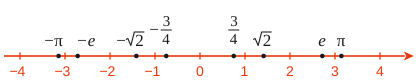
Figure 1. The real line: each real number corresponds to one of its points
This line is often called the real line. Each of its points (there are infinitely many) is associated, unambiguously, with one and only one real number. In other words, there is a one-to-one correspondence between the real numbers and the points of the line.
Figure 1 shows some rational numbers (3/4 and -3/4) and some real numbers, with their symmetric points with respect to the origin.
Is a similar representation possible for complex numbers?
The difficulty of representing \(i=\sqrt{-1}\) immediately arises.
There is simply no point on the line that can be associated with the imaginary unit \( i\), since \( i\) is not a real number.
If we multiply 1 by \( i^2\) we get −1, which is real and is represented by a point on the line. So we might think that \( i^2\) turns 1 into its opposite −1, which geometrically corresponds to rotating the segment [0,1] by 180°. But then, couldn't multiplying 1 by \( i \) mean rotating the segment [0,1] by 90°, so that \(i=\sqrt{-1}\) can be represented by a point on a line perpendicular to the real axis?
Caspar Wessel (1798), Argand (1806) and finally Gauss (1831) had precisely the brilliant idea of representing i, and all the other imaginary numbers, on another line perpendicular to the real line.
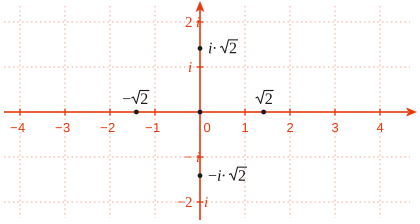
Figure 2. The Argand-Gauss plane. The real axis and the imaginary axis are perpendicular
This line is called the imaginary line or imaginary axis.
In the Gauss plane (as we will call it from now on) each complex number \( \dot z = a+ib\) is represented by a point, identified by an ordered pair of numbers:
\(\dot z = (a,b) \), where the first element of the pair is the real part and the second the imaginary part of \(\dot z\).
The real numbers are represented by all the pairs of the type \((a,0)\), the imaginary numbers by all the pairs \((0,b)\).
In particular, the imaginary unit \( i\) is represented by the pair \((0,1)\), and so \(\sqrt{-1}= (0,1)\).
 Load the interactive board showing the Gauss plane. You can drag the point z and watch, at the top
left, how the real and imaginary parts of the complex number represented by the point z change.
2.2 - Complex numbers and vectors
We have already pointed out that the product of a complex number and its conjugate gives a real quantity, which is always positive: \(\dot z \cdot \dot z^*=a^2+b^2\), whose square root \(r = \left | z \right | = \sqrt{a^2+b^2}\) we called the modulus of the complex number.In the Gauss plane, \(\left | z \right |\) is the (Euclidean) distance of the point \(\dot z \) from the origin. This leads us to think of a complex number not only as a point in the Gauss plane, but as a vector of magnitude \(\left | z \right |\) that represents the position of the point \(\dot z \) with respect to the origin of the axes.
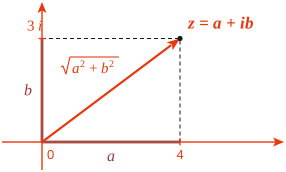
Figure 3. Vector representing the complex number z
Here too, however, we must be careful: it is not enough just to give a quantity a name. If we claim that \(\dot z \) is a vector, we have to prove that it really behaves like a vector.
For example, we should check that the vectors representing complex numbers add according to the parallelogram rule. This can in fact be seen easily on the board on the left.
So, given a number \(\dot z \) and a number \(\dot w \), let us show the number \(\dot s = \dot z + \dot w \) and the corresponding vectors
The difference \(\dot d = \dot z - \dot w \) also corresponds to the difference between vectors. The difference vector \(\dot d \) is simply the (dashed) difference vector moved so that it starts at the origin.
Product and division represented as vectors in the Gauss plane deserve a separate discussion, which we will take up after introducing another way of representing complex numbers: the polar form.
2.3 - Geometric interpretation of the product and division of complex numbers
For now let us show the product \(\dot p = \dot z \cdot \dot w \) (we choose \(\dot z \) and \(\dot w \) so that \(\dot p \) stays inside the visible area, for example \(\dot z = 2+i2 \) and \(\dot w=3+i1 \)).Now let us keep \(\dot z \) fixed and move the point \(\dot w \).
We notice something interesting: besides changing its magnitude, the vector \(\dot p \) is rotated by a certain angle.
 We can make this clearer by
imagining that the point \(\dot z \) is constrained to move along a circle. Consider a second number \(\dot w \) and suppose that its point in turn moves
along a circle. This amounts to changing
\(\dot z \) and \(\dot w \) while keeping their moduli constant. Let us watch how
the product \(\dot p = \dot z \cdot \dot w \) behaves.
Let us bring \(\dot w \) onto the real axis (\(\dot w =2 + i 0\)): we notice that the product vector \(\dot p = \dot z \cdot \dot w\) is parallel to \(\dot z \), that is, it lies
on the same line, and so it forms with the real axis the same angle as \(\dot z \). Now let us rotate \(\dot w \), for example counterclockwise. The product vector rotates too, keeping its magnitude constant. Let us look at the angle between \(\dot p \) and \(\dot z \). Let us compare it with the angle that \(\dot w \) forms with the real axis. These two
angles are clearly equal.
The angle that the vector representing a complex number forms with the real axis is called the argument of the complex number.
So the argument θ of \(\dot p \) is the sum of α, the argument of \(\dot z \), and β, the argument of \(\dot w \): θ = α + β. If we move \(\dot w \) into the fourth quadrant (positive real part, negative imaginary part), does this relation still hold? It might now seem that we have to subtract angles, because in this case the angle β is negative. So the relation θ = α + β still holds, and it holds for the other quadrants as well.
What can we say about the division \(\dot q =\dot z/ \dot w \) ?
Here too we place \(\dot w \) on the real axis and rotate \(\dot w \) counterclockwise. Now it seems clear that the angle δ, the argument of \(\dot q \), corresponds to the difference δ = α − β.
We will be able to prove these facts after introducing the trigonometric form of complex numbers.
2.4 - The imaginary unit as a rotation operator
The geometric role played by the imaginary unit \( i \), which
is itself represented by a vector of unit magnitude, is particularly important and interesting.After loading the board, let us see what happens when we multiply any complex number by \( i \).
Suppose, for example, that we multiply the number \(\dot z = 3 + i\; 2 \) by \( i \), applying the definition of the product and the property of the imaginary unit \( i^2 = -1 \):
\[ (3+i \; 2) \cdot i = 3 \; i + i^2 \; 2 = -2 + 3 \; i \] We notice that the magnitude does not change (the real and imaginary parts swap roles), but the vector \(\dot z \cdot i \) is rotated by 90° (\(\pi/2 \) radians) counterclockwise with respect to \( \dot z \).
What happens if we divide \( \dot z \) by \( i \)?
\[\frac {3 + i \; 2}{i} = \frac {(3 + i \; 2) \cdot (-i)}{i \cdot (-i)}= \frac {-3 \; i -i^2 \; 2}{-i^2}= \frac {-3 \; i +2}{1} \] Here we multiplied the numerator and the denominator by \( -i \) (the complex conjugate of \( i \)) to get 1 in the denominator, so:
\[ \frac {3+i \; 2}{i} = 2 - 3 \; i \] In this case the vector \( \dot z / i \) still has the same magnitude as \( \dot z \), but it is rotated by 90° clockwise (a rotation of −90°, \(-\pi/2 \) radians).
From this we can also see that dividing by \( i \) is equivalent to multiplying by \( -i \):
\[ \frac {1}{i} = \frac {1 \cdot (-i)}{i \cdot (-i)} = \frac {-i}{-i^2}= \frac {-i}{1} = -i \] In conclusion, from a geometric point of view the imaginary unit \( i \) behaves in every respect like an operator that rotates by 90°, or \( \pi /2 \) radians:
| \( \dot z \cdot i \) ⇒ rotates \( \dot z \) by +90° (a 90° counterclockwise rotation) |
| \( \dot z \cdot (-i) = \dot z /i \) ⇒ rotates \( \dot z \) by −90° (a 90° clockwise rotation) |
We can multiply by \( i \) repeatedly. Multiplying twice:
\[ \dot z \cdot i \cdot i = \dot z \cdot i^2 = \dot z \cdot (-1) = - \dot z \] which is equivalent to a 180° rotation. Indeed, changing the sign of a complex number rotates the vector that represents it by 180° (opposite vector).
Example: \[ (3+i\;2) \cdot i^2 = (3+i\;2) \cdot (-1)= -3 - i\;2\] which represents the opposite of the vector \( \dot z \).
Likewise: \[ i \cdot i \cdot i = i^3 = i^2 \cdot i = (-1) \cdot i = -i \] is equivalent to a rotation of −90°, which we know corresponds to 270° (3 consecutive rotations of 90°).
Example: \[ (3+i\;2) \cdot i^3 = (3+i\;2) \cdot (-i)= -3 \;i - i^2\;2= 2 - i \; 3\] which can be checked by moving the vector \( \dot w \) so that \(\dot w = 2 - i \; 3\), seeing also visually that \(\dot w = \dot z \cdot i^3\) has been rotated by 270° from its original position.
Finally: \[ i \cdot i \cdot i \cdot i = i^4 = i^2 \cdot i^2 =(-1) \cdot (-1) = 1 \] which means leaving the vector unchanged (it is multiplied by 1). However, a zero rotation cannot be distinguished from a 360° rotation, and this is consistent with the geometric interpretation given to multiplication by \( i \).
To sum up:
| multiplication by | rotation |
| \( i \) | 90° |
| \( i^2 \) | 180° |
| \( i^3 \) | 270° |
| \( i^4 \) | 360° |
3 - Trigonometric and polar form of complex numbers
Besides the algebraic form \( a + i\;b \) of a complex number, there are two other important ways of representing complex numbers: the trigonometric form and the polar form. Note: from here on, to keep the notation simple, we will no longer use the dot for multiplication.3.1 - The trigonometric form of complex numbers
Given the complex number \( \dot z = a + i\;b \), the quantity \( r_z= \sqrt {a^2+b^2} \)
is both the modulus
of the complex number and the magnitude of the corresponding vector in the Gauss plane.The modulus \( r_z \) equals the radius of the circle on which we move the point \( \dot z \).
Now imagine projecting the vector \( \dot z \) onto the real axis.
The vector forms the angle α with the real axis; the angle α is called the argument of the complex number \( \dot z \), is written Arg(z) and is sometimes also called the phase angle or simply the phase.
Thanks to the well-known trigonometric relations between the sides of a right triangle, the projection is given by \( r_z\,cos\;\alpha \).
In the same way, let us project \( \dot z \) onto the imaginary axis. This projection is given by \( r_z\,sin\;\alpha \).
Clearly \( r_z\,cos\;\alpha= a \) is the real part of the complex number, while \( r_z\,sin\;\alpha= b \) is its imaginary part.
So we have: \( \dot z = a + i\;b = r_z\,cos\;\alpha + i\;r_z\,sin\;\alpha= r_z\,(cos\;\alpha + i\; sin\;\alpha) \) The trigonometric form of the complex number \( \dot z \) is then:
\[ \dot z = r_z\,(cos\;\alpha + i\; sin\;\alpha) \] The trigonometric representation of complex numbers is not unique: because sine and cosine are periodic functions, we also have:
\[ \dot z = r_z\,[cos (\alpha+ 2 k \pi) + i\; sin (\alpha + 2 k \pi)] \hspace{1 cm} ( k = 0, 1, 2, ... ) \]
To avoid this ambiguity, we can take \( -\pi < \alpha < \pi \), in which case \( \alpha \) is called the principal value of Arg(\( \dot z\)) and is sometimes written arg(\( \dot z\)) (see also section 3.5 for more on this topic).
The complex conjugate of \( \dot z\) is:
\[ \dot z^* = r_z\,(cos\;\alpha - i\; sin\;\alpha) \]
We can now prove what we saw in the previous section about the product and the division.
The trigonometric form of the number \( \dot w\) with modulus \( w = r_w \) and argument \( \beta \) is:
\[ \dot w = r_w\,(cos\;\beta + i\; sin\;\beta) \]
3.2 - Product of complex numbers in trigonometric form
The product \( \dot z\,\dot w = r_z\;r_w\,(cos\;\alpha + i\; sin\;\alpha)(cos\;\beta + i\; sin\;\beta)\) is obtained by applying the definitions seen above:\[ \dot z\,\dot w = r_z \; r_w [(cos\;\alpha\; cos\;\beta - sin\;\alpha\; sin\;\beta) + i\;( sin\;\alpha\; cos\;\beta+cos\;\alpha\; sin\;\beta) ] \] We notice that the square brackets contain the angle addition formulas for cosine and sine, so:
| \[ \dot z\,\dot w = r_z \; r_w [cos(\alpha +\beta) + i\; sin(\alpha +\beta)] \] |
We conclude that the product \(\dot z \; \dot w \) of the two complex numbers is represented by a vector whose magnitude is the product of the moduli and whose argument is the sum of the arguments, as shown in the previous section.
3.3 - Division of complex numbers in trigonometric form
To compute the quotient \[ \frac{\dot z } { \dot w\ } = \frac {r_z\;(cos\;\alpha + i\; sin\;\alpha) }{ r_w \;(cos\;\beta + i\; sin\;\beta)} \] we multiply the numerator and the denominator by \( cos\;\beta - i\; sin\;\beta\), which is the complex conjugate of the denominator apart from the modulus.In the denominator we get:
\( r_w\;(cos\;\beta + i\; sin\;\beta)(cos\;\beta - i\; sin\;\beta)= r_w\;[cos^2 (\beta) + sin^2 (\beta)]=r_w\) since the expression in brackets equals 1 by the fundamental identity of trigonometry.
So we have:
\[ \frac{\dot z } { \dot w\ } = \frac {r_z\;(cos\;\alpha + i\; sin\;\alpha)(cos\;\beta - i\; sin\;\beta) }{ r_w } \] and, carrying out the multiplication:
\[ \frac{\dot z } { \dot w\ } = \frac {r_z}{ r_w } \; [ (cos\;\alpha\; cos\;\beta + sin\;\alpha\; sin\;\beta)+ i \; (sin\;\alpha\; cos\;\beta - cos\;\alpha\; sin\;\beta ) ] \]
In the square brackets we recognize the angle subtraction formulas for cosine and sine, so the quotient of the two complex numbers is:
| \[ \frac{\dot z } { \dot w\ } = \frac {r_z}{ r_w } \; [cos (\alpha -\beta) + i \; sin (\alpha -\beta) ] \] |
The quotient \(\frac{\dot z } { \dot w\ } \) of two complex numbers is represented by a vector whose magnitude is the quotient of the moduli and whose argument is the difference of the arguments.
3.4 - Polar form of complex numbers
The considerations in the previous section lead us to another way of representing complex numbers: the so-called polar form, which highlights the modulus and the argument using the notation \( modulus \angle argument\), where the first number is the magnitude of the vector and the second the angle with the real axis (in degrees or radians: in technical practice degrees are preferred), separated by the symbol \( \angle \), which indicates that the number following it is the measure of an angle.3.5 - From algebraic form to polar form and back
If the complex number is given in algebraic form, for example the number \( \dot z = 4+i\;3 \), we have to
compute the modulus
\( r_z= \sqrt {4^2+3^2}= \sqrt 25 =5\), and
then the argument. For this, note that the
tangent of the argument \( \alpha \) is the ratio of the imaginary part to the
real part of the complex number, in our case
\( tan\;\alpha = \frac {3}{4}= 0.75 \)
so
\( \alpha = arctan\;0.75=36.87°\), or \( 0.64\) radians.In polar form we have \( \dot z = 5 \;\angle \;36.87°\) or \( \dot z = 5\; \angle \;0.64\)
So, to go from algebraic form to polar form:
| \( a+ i\;b \; \rightarrow\; \sqrt {a^2+b^2}\; \angle\;arctan(b/a)\) |
A remark is needed about the argument \( \alpha =arctan(b/a)\).
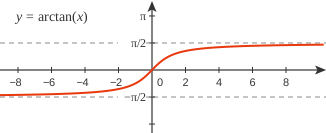 As the figure shows, the
range of the arctangent function is the open interval \( ]- \frac{\pi}{2}, +\frac{\pi}{2}[ \).
There is no problem in computing the angle if the complex number lies in the first (a>0, b>0) or in the fourth (a>0, b<0) quadrant.
If the vector lies in the second quadrant (a<0, b≥0), the result of arctan(b/a) will be a negative value (e.g. −2+i3, arctan(3/(-2)) = −0.983 (−56.31°)), which is clearly wrong. In this case we must add π to the angle found: −0.983 + π = 2.159 rad ( −56.31° + 180° = 123.7°).
Similarly, in the third quadrant (e.g. −2−i3), arctan((-3)/(-2)) = +0.983 (+56.31°). In this case we add π if we want the convex angle (positive angle): 0.983 + π = 4.125 rad ( +56.31° + 180° = 236.31°), or we subtract π if we want the representation with a reflex angle (negative angle) : 0.983 − π = −2.159 rad ( +56.31° − 180° = −123.69°).
If the real part is zero (e.g. 0+i3), we obviously cannot compute the angle with arctan(b/0), but it is clear that in this case the argument will be ± π/2 (±90°), depending on the sign of the imaginary part.
To sum up:
if \( \dot z = a + i\;b = r_z\,(cos\;\alpha + i\; sin\;\alpha) \), its polar form is:
| \( \dot z = r_z \; \angle\;\alpha\) |
and the polar form of its complex conjugate \( \dot z^* = r_z\,(cos\;\alpha - i\; sin\;\alpha)\), since we can also write \( \dot z^* = r_z\,[cos (-\alpha) + i\; sin (-\alpha)] \), is:
| \( \dot z^* = r_z \; \angle\;-\alpha\) |
\( -\pi < \alpha < +\pi \) is the principal value of Arg(\( \dot z \)).
Often, especially in technical use, the argument is expressed in degrees, and then: \( -180° < \alpha < +180° \)
For the inverse transformation, from polar to algebraic form, we use the trigonometric form:
| \( r_z \;\angle \alpha \; \rightarrow \; r_z \; (cos\;\alpha + i\; sin\;\alpha) \) |
3.6 - Multiplication and division in polar form
Thanks to the trigonometric form we have already shown (3.1 and 3.2) that the product of two complex numbers is a complex number whose modulus is the product of the moduli and whose argument is the sum of the arguments. This translates directly into the rule for the product in polar form:| \( r_z\;\angle\;\alpha \cdot r_w \;\angle\;\beta= r_z \; r_w \;\angle\;\alpha+\beta \) |
The same applies to division:
| \[ \frac{r_z\;\angle\;\alpha}{ r_w \;\angle\;\beta} = \frac{r_z}{r_w} \;\angle\;\alpha-\beta \] |
which is a number whose modulus is the quotient of the moduli and whose argument is the difference of the arguments.
When doing the calculations, it is convenient to multiply and divide numbers in polar form, but addition and subtraction can only be done in algebraic form.
Example:
Multiply the numbers \( \dot z = \)\( -2 + i\;3\)
and \( \dot w = \)\( 2 + i\;1\)
using the rule for multiplication in polar form.Let us convert them to polar form:
\( r_z = \sqrt{2^2+3^2}=\sqrt{13}=3.606 \hspace{0.5cm} \alpha= arctan(3/-2)+180°= -56.31° +180°=123.69°\)
\( r_w = \sqrt{2^2+1^2}=\sqrt{5}=2.236 \hspace{0.5cm} \beta= arctan(1/2)=26.57°\)
so \(\hspace{1cm} \dot z = 3.606 \;\angle\;123.69° \) and \( \dot w = 2.236 \;\angle\;26.57° \)
Product and quotient give:
\(\dot z\,\dot w\) \( = 3.606 \;\angle\;123.69° \cdot 2.236 \;\angle\;26.57° = 8.06\;\angle\;150.26° \)
\(\frac{\dot z}{ \dot w}\) \(=\) \( \frac{3.606 \;\angle\;123.69°}{ 2.236 \;\angle\;26.57°}\) \(= 1.612 \;\angle\;97.12°\)
Let us convert the results to algebraic form:
\(\dot z\,\dot w\) \(\begin{aligned}&= 8.06\;\angle\;150.26° = 8.06 (cos\;150.26°+ i\;sin\;150.26°) \\ &= 8.06 (-0.868+i\;0.496)=-7+ i\;4\end{aligned}\)
\(\frac{\dot z}{ \dot w}\) \(\begin{aligned}&= 1.612 \;\angle\;97.12° = 1.612 (cos\;97.12°+ i\;sin\;97.12°) \\ &= 1.612 (-0.124+ i\;0.992)= -0.2+i\;1.6\end{aligned}\)
where, for convenience, we have taken the formal liberty of writing the arguments of sine and cosine in degrees rather than in radians, as we should.
4 - Powers of complex numbers. De Moivre's formula
Having considered the basic operations between complex numbers, we naturally ask whether, and how, the concept of raising to a power can be applied to them.4.1 - Integer powers of a complex number
Raising a real number a to the power n means, as we know, multiplying a by itself n times: an = a⋅a⋅a...⋅a (n times).Let us extend this definition to complex numbers:
(a +ib)n = (a +ib)⋅(a +ib)⋅(a +ib)...⋅(a +ib) (n times)
and assume that the well-known properties of powers hold:
- z n⋅z m = z n+m
- z n / z m = z n−m
- (z n )m = z n⋅m
- z 1/n= n√z
- z n⋅w n = (z⋅w)n
\[ \dot z^n = r_z^n \; (cos\;\alpha + i\; sin\;\alpha)^n \]
where we have applied property V of powers: the power of a product is equal to the product of the powers.
4.2 - An interesting property of the number \(cos \; \alpha + i\; sin\; \alpha\)
The number \(cos \; \alpha + i\; sin\; \alpha\), which
we will call \(\dot u_\alpha\) (u for unit),
has some
interesting properties that are worth
dwelling on. First of all, as α varies, it represents
any complex number
of unit modulus, since \(cos^2 \; \alpha + sin^2\; \alpha =1\) .
For this reason, when multiplied by another number, it changes only its argument, and so it acts as a
true operator of rotation by α radians.Let us check this with an example.
Let \(\alpha = \pi/3\) (60°), so: \[cos \; \alpha + i\; sin\; \alpha=cos \;\frac{\pi}{3} + i \: sin \;\frac{\pi}{3} =\frac{1}{2}+ i\; \frac{\sqrt{3}}{2}\] Now let us multiply any other complex number \(\dot w\), for example \(3 + i\; 2\), by this number:
\[(3 + i\; 2)\left ( \frac{1}{2}+ i\; \frac{\sqrt{3}}{2} \right )= \frac{3}{2}+ i\;\frac{3\;\sqrt{3}}{2}+ i+i^2\;\sqrt{3}=\frac{3}{2}-\sqrt{3}+i\;\frac{3\;\sqrt{3}+2}{2}=-0.232 +i \;3.6\] in polar form: \(-0.232 +i \;3.6 \rightarrow 3.61 \angle 93.69°\) (watch out for the negative real part)
If we compute the polar form of \(\dot w\) we get \(3 +i \;2 \rightarrow 3.61 \angle 33.69°\). We notice that 93.69° − 33.69° = 60°, while of course the modulus has not changed.
So multiplying by \(cos \;\frac{\pi}{3} + i \: sin \;\frac{\pi}{3}\) has rotated the vector \(3+ i\;2\) by \(\pi/3\) radians counterclockwise.
The inverse operation, that is, dividing by \(cos \;\frac{\pi}{3} + i \: sin \;\frac{\pi}{3}\), instead produces a rotation of \(\pi/3\) radians clockwise, as is easy to check. In the latter case, taking - as usual - the counterclockwise direction as positive for angles, we can say that the division produces a rotation of \(-\pi/3\) radians.
This is completely general: multiplying any vector by \(cos \; \alpha + i\; sin\; \alpha\) (in polar form \(1 \angle \alpha\)) rotates it by \(\alpha\) radians, counterclockwise if \(\alpha\) is positive, clockwise otherwise.
Dividing any vector by \(cos \; \alpha + i\; sin\; \alpha\) rotates it clockwise for \(\alpha> 0\), counterclockwise otherwise. In fact, we will show later that: \[\frac {1}{cos \; \alpha + i\; sin\; \alpha} = cos \; (-\alpha) + i\; sin\; (-\alpha)\]
Zoom the view in or out:
4.3 - De Moivre's formula
De Moivre's formula states that, given an integer n:\[(cos \; \alpha + i\; sin\; \alpha)^n = cos \; n\alpha + i\; sin\; n\alpha\] Let us consider again the vector \(\dot u_{\alpha}= cos \; \alpha + i\; sin\; \alpha\) and, for now, let us try to compute \((cos \; \alpha + i\; sin\; \alpha)^2\):
\((cos \; \alpha + i\; sin\; \alpha)^2 =(cos \; \alpha + i\; sin\; \alpha)(cos \; \alpha + i\; sin\; \alpha)=cos^2 \alpha - sin^2 \alpha + i \;2 sin\;\alpha \; cos\;\alpha \)
From trigonometry we know that \(cos^2 \; \alpha - sin^2 \; \alpha = cos\; 2\alpha \) and \( 2\;sin \alpha \; cos \alpha = sin \; 2\alpha \) are the so-called double-angle formulas. Highlighting the argument of \((cos \; \alpha + i\; sin\; \alpha)^2\), we immediately see that it is twice \(\alpha\).
So we have proved De Moivre's formula at least for the case n = 2, that is:
\[(cos \; \alpha + i\; sin\; \alpha)^2 = cos \; 2\alpha + i\; sin\; 2\alpha\] It is fairly easy to prove it for n = 3, 4, ... as well; however, since we cannot go on indefinitely with these checks ( n → ∞), we must look for a general proof of the formula.
4.4 - Proof of De Moivre's formula by induction
There is a very powerful technique of mathematical proof: proof by induction.It goes like this:
- The statement is proved for a particular case, for example n = 1 (base case);
- It is proved that if the statement holds for a generic case n, then it also holds for n+1 (inductive step);
- Since n can be any number, we conclude that the statement is true in general, and so it is proved (conclusion).
We have to prove that: \((cos \; \alpha + i\; sin\; \alpha)^n = cos \; n \alpha + i\; sin\; n \alpha\)
- BASE CASE:
for n=1, \((cos \; \alpha + i\; sin\; \alpha)^1 = cos \; 1 \alpha + i\; sin\; 1 \alpha\) is trivially true; - now suppose that
\((cos \; \alpha + i\; sin\; \alpha)^n = cos \; n \alpha + i\; sin\; n \alpha\) is true for some n;
let us show that it is then also true for n+1, that is:
INDUCTIVE STEP:
if \((cos \; \alpha + i\; sin\; \alpha)^n = cos \; n \alpha + i\; sin\; n \alpha\) is true
then \( (cos \; \alpha + i\; sin\; \alpha)^{n+1} = cos \; (n+1) \alpha + i\; sin\; (n+1) \alpha\) is true
By property I of powers (section 4.1):
\((cos \; \alpha + i\; sin\; \alpha)^{n+1} = (cos \; \alpha + i\; sin\; \alpha)^n\,(cos \; \alpha + i\; sin\; \alpha)\)
but we assumed that \((cos \; \alpha + i\; sin\; \alpha)^n = cos \; n \alpha + i\; sin\; n \alpha\), so:
\((cos \; \alpha + i\; sin\; \alpha)^{n+1} = (cos \;n \alpha + i\; sin\; n\alpha)(cos \; \alpha + i\; sin\; \alpha)\)
Setting \(n \alpha =\beta\), and so \((cos \;n \alpha + i\; sin\; n\alpha) = (cos \; \beta + i\; sin\; \beta)\), we carry out the multiplication:
\(\begin{aligned}&(cos \; \beta + i\; sin\; \beta)(cos \; \alpha + i\; sin\; \alpha)\\ &= cos\, \beta\;cos\;\alpha +i^2 sin\;\beta\;sin\;\alpha+ i\;(sin\;\beta\;cos\;\alpha+sin\:\alpha\;cos\;\beta)\\ &= cos\, \beta\;cos\;\alpha - sin\;\beta\;sin\;\alpha+ i\;(sin\;\beta\;cos\;\alpha+sin\:\alpha\;cos\;\beta)\\ &= cos\;(\beta+\alpha)+i\;sin\;(\beta+\alpha)= cos\;(n \alpha+\alpha)+i\;sin\;(n \alpha+\alpha)\\ &= cos\;(n+1) \alpha+i\;sin\;(n+1)\alpha\end{aligned}\)
This proves that:
\[ (cos \; \alpha + i\; sin\; \alpha)^{n+1} = cos \; (n+1) \alpha + i\; sin\; (n+1) \alpha\] -
Since we have placed no
restriction on n, it can
take any value (from 1 to ∞), and so
De Moivre's formula
\[(cos \; \alpha + i\; sin\; \alpha)^n = cos \; n\alpha + i\; sin\; n\alpha\] is proved.
\[[r_z\;(cos \; \alpha + i\; sin\; \alpha)]^n = r_z^n \;(cos \; n\alpha + i\; sin\; n\alpha)\]
5 - Roots of a complex number
The inverse operation of raising to a power is taking a root.The number \(\dot w\) is the n-th root of \(\dot z\) if \(\dot w^n = \dot z\), with integer n.
As is well known, taking the n-th root is equivalent to raising to the power 1/n:
\[ (\dot w^n)^{\frac{1} {n}} = \dot z^{\frac {1}{n}} \Rightarrow \dot w ^{\frac{n}{n}} = \dot z^{\frac {1}{n}} \Rightarrow \dot w = \dot z^{\frac {1}{n}} \Rightarrow \dot w = \sqrt[n] {\dot z}\]
5.1 - Square root of a complex number in algebraic form
If \(\hspace {0.3cm} \dot w = a+i\;b \hspace{0.3cm}\) and \(\hspace {0.3cm} \dot z = u+i\;v \hspace {0.3cm}\), from the relations above we have:\[ (a+i\;b)^2 = u+i\;v \] that is:
\[ a^2 - b^2 + i\;2ab = u + i\;v \]
Two complex numbers are equal if their real parts and their imaginary parts are equal, so:
\[\begin{cases} a^2-b^2 = u \\ 2ab = v \end{cases}\]
the solution of the system gives:
\[ \sqrt{\dot z}= \pm \sqrt { \frac {u+\sqrt{u^2+v^2}}{2} } \pm i\;\sqrt { \frac {-u+\sqrt{u^2+v^2}}{2} } = a + i\;b \]
It is instructive to compute the square root
of some particular numbers.For \(\dot z =\) \(4 + i\;0\) ( u=4, v=0), substituting into the formula above we get the square root:
\( \hspace{1cm} \sqrt{\dot z} \) \( = a+i\;b = \pm (\sqrt{8/2}+ i\; \sqrt{0}) = \pm 2\), as we expect.
Now let us try \(\dot z =\) \(0 + i\;4\) (u=0, v=4):
\( \sqrt{\dot z} \) \( = a+i\;b = \pm (\sqrt{4/2}+ i\; \sqrt{4/2}) = \pm (\sqrt{2}+ i\: \sqrt{2})\)
An interesting fact: the square root of the imaginary number \( i\;4\) is not a pure imaginary number (for example \( i\;2\)) but the complex number \(\pm (\sqrt{2}+ i\: \sqrt{2})\):
\[ \sqrt{i\;4} = \pm (\sqrt{2}+ i\: \sqrt{2})\] The polar form of the positive root clearly shows that its argument is half that of the radicand: \( \sqrt{2}+ i\: \sqrt{2} \rightarrow 2 \angle\; 45° \)
As we expected, there are 2 roots.
5.2 - Example: the cube root (n = 3) of a complex number
Suppose we want
to find the cube root of 8.
In the real field there is only one solution: \( \sqrt[3]{8}=2\). However, we now know that a real number is nothing but a complex number with zero imaginary part: \( 8 = \)\(\; 8+ i\: 0\; \).
What happens if we take the cube root of this number, \( \sqrt[3]{8 +i\;0}\; \)? Will we still get a single solution?
Following the reasoning of the previous section, if the number \( a + i\;b\) is the cube root we are looking for, then:
\[ (a + i\;b)^3 = u + i\; v \] that is (5):
\[ a^3 + (i\;b)^3 + i\;3a^2b + i^2 3ab^2 = u + i\; v \] Now, remembering that \( i^2 = -1\), \( i^3 = -i\), and therefore \( (i\;b)^3 = -i\;b^3\):
\[ (a^3 - 3ab^2) +i\;(3a^2b -b^3) = u + i\; v \] In our particular case:
\[ (a^3 - 3ab^2) +i\;(3a^2b -b^3) = 8 + i\; 0 \] So we have to equate the real parts and the imaginary parts:
\[\begin{cases} a^3-3ab^2=8 \\ 3a^2b-b^3 = 0 \end{cases}\] Factoring out the common factor in the second equation, \(3a^2b-b^3 = 0 \), we get \( b(3a^2-b^2)=0 \), which gives the three solutions: \(b = 0;\; b = a\sqrt{3};\; b= -a\sqrt{3} \).
1) For \(b = 0\) the second equation reduces to the identity 0 = 0, and the same holds for the other two cases:
\[\begin{cases} a^3-3ab^2=8 \\ 3a^2b-b^3 = 0 \end{cases} \hspace{1cm} \begin{cases} a^3 = 8 \\ 0 = 0 \end{cases} \hspace{0.5cm} \Rightarrow \hspace{0.5cm} \begin{cases} a = 2 \\ b = 0 \end{cases} \]
so we have the solution \(2 + i\;0\)
2) For \(b = a\sqrt{3}\):
\[\begin{cases} a^3-3a(a\sqrt{3})^2=8 \\ 3a^2a\sqrt{3}-(a\sqrt{3})^3 = 0 \end{cases} \hspace{1cm} \begin{cases} a^3-9a^3=8 \\ 0 = 0 \end{cases} \hspace{1cm} \begin{cases} a^3=-1 \\ 0 = 0 \end{cases} \hspace{0.5cm} \Rightarrow \hspace{0.5cm} \begin{cases} a=-1 \\ b= -\sqrt{3} \end{cases}\]
which gives the solution \(-1 - i\;\sqrt{3}\)
3) For \( b= -a\sqrt{3} \)
\[\begin{cases} a^3-3a(-a\sqrt{3})^2=8 \\ 3a^2(-a\sqrt{3})-(-a\sqrt{3})^3 = 0 \end{cases} \hspace{0.6cm} \begin{cases} a^3-9a^3=8 \\ 0 = 0 \end{cases} \hspace{0.6cm} \begin{cases} a^3=-1 \\ 0 = 0 \end{cases} \hspace{0.5cm} \Rightarrow \hspace{0.5cm} \begin{cases} a=-1 \\ b= +\sqrt{3} \end{cases}\] which gives the solution \(-1 + i\;\sqrt{3}\)
So the root \( \sqrt[3]{8 +i\;0}\; \) has three solutions in the complex field:
\( 2 + i\;0; \;-1 - i\;\sqrt{3};\;-1 + i\;\sqrt{3}\)
5.3 - Roots and algebraic equations
It is interesting to note that, in the complex field, the number of roots (from the example, at least up to n = 3) seems to be equal to the index of the root itself. That is, given \( \sqrt[n]{x}\), with complex x and integer n, we would have two roots for n = 2, three roots for n = 3.If this were so, and if this conjecture were true for every n, the situation would be more satisfactory than what happens in the real field, where \( \sqrt[n]{x}\) has no solutions if n is even and x < 0, while it has 1 solution if n is odd, and two if n is even and x > 0.
On the other hand, taking the root of index n is in some way related to the existence of solutions (which, not by chance, we call roots) of algebraic equations of degree n, such as \( a_n x^n + a_{n-1}x^{n-1} + a_{n-2}x^{n-2} + ... + a_2 x^2 + a_1 x^1 + a_0 = 0\), where the coefficients ai and the variable x are, in the most general case, complex numbers.
For example, finding \( \sqrt{4096}\) is equivalent to solving the quadratic equation \(x^2= 4096 \) , which gives the two real solutions x = 64 and x = −64.
Taking the cube root of 4096, \( \sqrt[3]{4096}\) , means solving the cubic equation \( x^3 = 4096\), which has the single real solution x = 16.
Taking the fourth root, \( \sqrt[4]{4096}\) , is equivalent to solving the quartic equation \( x^4 = 4096\).
This is a biquadratic equation, which can be solved with the well-known technique of substituting the variable:
if we set \( t = x^2\), the equation becomes \( t^2 = 4096\), which, as before, gives the real solutions t= 64 and t = −64.
The quartic equation is then equivalent to the two quadratic equations:
- \( x^2 = 64\)
- \( x^2 = -64\)
The second equation, instead, has no solutions in the field of real numbers.
5.4 - Algebraic closure, or: how many kinds of numbers do we need?
The fact that there are equations that cannot be solved , or operations that cannot be performed within a certain algebraic structure (in technical language we would say that the structure is not algebraically closed), is a strong motivation for introducing new kinds of numbers. The field of reals is not closed under taking square roots, because this operation cannot be performed on negative real numbers. The complex field, instead, is closed under this operation.New kinds of numbers have been introduced over time to solve problems of algebraic closure:
the integers ℤ solve the problem of subtractions such as 3− 5, which are impossible within the natural numbers;
the rationals ℚ allow division between integers that are not divisible, e.g. 3 : 5;
with the reals ℝ we tackle more delicate questions such as the existence of irrational numbers (such as √2) and of transcendental numbers such as e, Euler's number, or π, pi, the ratio of a circle's circumference to its diameter;
the complex numbers ℂ are the algebraic closure of the real numbers. A theorem whose proof is beyond the scope of this lesson, called the fundamental theorem of algebra, guarantees that all algebraic operations and equations can be solved in the complex field, and so there is no need, now or in the future, to resort to new kinds of numbers.
5.5 - The n-th root of a complex number
Let us now try to show
that we can take the root of
integer index n of a complex number for any n, and that
the number
of these roots is equal to the index n. For this it is useful to use
the trigonometric representation of complex numbers.In section 4.4 we proved the important De Moivre's formula:
\[(cos \; \alpha + i\; sin\; \alpha)^n = cos \; n\alpha + i\; sin\; n\alpha\]
thanks to which the integer n-th power of a complex number can be written as:
\[[z\;(cos \; \alpha + i\; sin\; \alpha)]^n = z^n \;(cos \; n\alpha + i\; sin\; n\alpha)\]
where z (z = rz) is the modulus of the complex number, and is always positive.
Now imagine computing the n-th root of \(\dot w = w\; (cos \; \beta + i\; sin\; \beta)\), and suppose this root is \(\dot z \): \(\sqrt[n]{\dot w} = \dot w^{\frac {1}{n}} = \dot z \). Then \(\dot z^n = \dot w \), that is:
\[ z^n \;(cos \; n\alpha + i\; sin\; n\alpha)= w\; (cos \; \beta + i\; sin\; \beta)\]
For this equality to hold we must have: \[\begin{cases} z^n = w \\ cos\; n\alpha = cos \; \beta \\ sin \;n\alpha = sin \;\beta \end{cases}\]
However, we know that the trigonometric functions sine and cosine are periodic with period \(2 \pi \), so we must have:
\[n \alpha= \beta + 2 k \pi \hspace{1cm} k = 0, \pm 1, \pm 2, \pm 3, ... \]
From this equation we get:
\[\alpha= \frac{ \beta}{n} + \frac{2 k \pi}{n} \hspace{1cm} k = 0, \pm 1, \pm 2, \pm 3, ... \] If k ∈ ℤ, we get values of α that repeat, and therefore roots that are not distinct.
If, for example, we give k the value n, we have \(\alpha= \frac{ \beta}{n} + \frac{2 n \pi}{n}\) and so \(\alpha= \frac{ \beta}{n} + 2 \pi \), which is again equal to \( \frac{ \beta}{n}\).
So, to get distinct roots, the largest value of k will be n −1, since for k = n we would get a root already found with k = 0.
If we consider negative values, for example k= −1, we have \(\alpha= \frac{ \beta}{n} - \frac {2 \pi}{n}\), which, however, is equal to \(\alpha= (\frac{ \beta}{n} - \frac {2 \pi}{n})+ 2\pi = \frac{ \beta}{n} +2 \pi \frac{n-1}{n} \), a value we would also get with k = n −1.
Continuing in this way, it is easy to check that the value of α for k = −2 can also be obtained with k = n −2. So we can restrict ourselves to positive values of k.
Every complex number therefore has n distinct roots, given by:
\[\sqrt[n]{\dot w} = w^{\frac{1}{n}} \left( cos \frac{ \beta +2 k \pi}{n} + i\;sin \frac{ \beta +2 k \pi}{n} \right) \hspace{1cm} k = 0, 1, 2, ..., n-1 \]
5.6 - The roots of unity
As we have seen, the unit in the complex
field is the number \(\dot 1 = 1 + i\;0\),
or the pair (1,0).If zn = 1, then z represents the n-th roots of unity.
In this case the formula above gives (β = 0 ):
\[\sqrt[n]{1 + i\;0} = \left( cos \frac{ 2 k \pi}{n} + i\;sin \frac{ 2 k \pi}{n} \right) \hspace{1cm} k = 0, 1, 2, ..., n-1 \]

Books by the author and further reading
Books by the author
Rev. October-November 2026

(2) In some fields, for example electrical engineering and electronics, to avoid confusion with the symbol for current intensity, people prefer to use j = √−1 instead of i as the symbol for the imaginary unit.
(3) Of course, when generalizing, we try to apply rules and definitions already used for other kinds of numbers.
(4) Here we use a simplified notation for the trigonometric functions: cos(α) → cos α, sin(α) → sin α.
(5) Compare with the cube of a binomial: (a+b)3 = a3 + b3 + 3a2b + 3ab2.